
Vehicle intelligence
Five answers per vehicle. One expensive problem to solve.
How we helped a client challenge commercial Vehicle Intelligence software, from an initial feasibility study to cloud deployment and Edge AI.
Pink Koala | Mountain View, California | November 5, 2026
The result first
Our system came out on top in comparisons with the commercial solutions tested. Against Rekor, a publicly traded vehicle intelligence company, our system was correct in 74% of contested cases, meaning cases where the two systems disagreed on the license plate number or state.
Not bad for a project that started with a simple question: Could we build something better ourselves?
The problem: expensive software, disappointing results
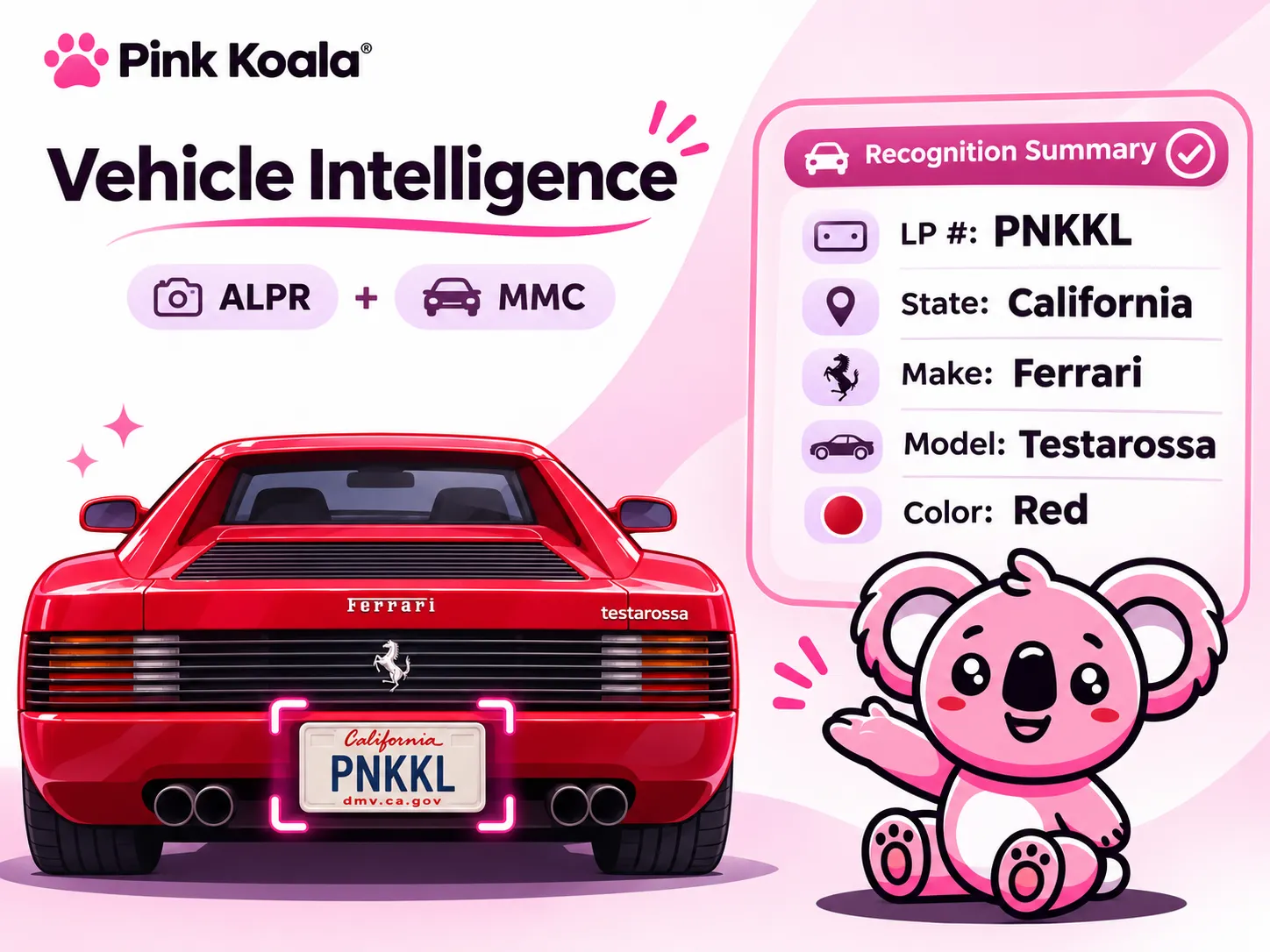
Our client operates a network of traffic cameras and needs five answers about every vehicle: license plate number, state, make, model, and color.
The commercial software they were using was expensive, and its accuracy left plenty of room for improvement.
The goal was straightforward: better recognition, lower operating costs, and freedom from substantial recurring software licensing fees.
But building a replacement was a significant investment. We needed to establish feasibility before committing to the full project.
First, prove it can work
We started small, with a feasibility study focused on one of the hardest challenges: license plate reading.
Real-world plates come with shadows, reflections, motion blur, strange angles, and occasionally very uncooperative lighting.
We explored an architecture combining convolutional neural networks (CNNs), Transformer attention, and CTC sequence decoding. Nothing exotic by 2026 standards. The challenge was making it work reliably on messy images.
The results approached the performance of the existing software, and our initial investigations of the other recognition tasks were encouraging.
The client had enough evidence to move forward.
Then, build the real thing
We worked in successive phases, each with clear objectives. The client could assess progress, adjust priorities, and decide whether to continue.
We built an MLOps infrastructure around MLflow, parallel GPU training, automated benchmarking, and systematic experimentation with architectures, hyperparameters, and data augmentation.
But some of the hardest problems weren’t about neural networks.
At the time, the client’s cameras were concentrated in three US states. We wanted coverage across all 50 states, ideally extending to Canada and Mexico. We also needed greater diversity in camera models, viewing angles, lighting conditions, and environments. That meant actively sourcing additional images, acquiring private datasets, and building more representative training data.
Vehicle make and model classification presented another challenge: different names for essentially identical cars, and different generations that barely resembled each other. Defining what the AI should recognize became an engineering project of its own.
Sometimes better data and clearer categories mattered more than a more sophisticated model.
From training to deployment
We didn’t stop at delivering trained models. We implemented the cloud inference system, including AWS orchestration, GPU workers, queues, and the infrastructure needed to coordinate multiple AI models efficiently. We also explored lower-cost GPU providers and optimized for latency, throughput, and operating costs.
Edge hardware was a different story. We developed and tested models for constrained devices, including single-board computers and intelligent cameras, but did not implement the camera-side orchestration.
That work belonged to a fantastic team of Mexican engineers who specialize in camera systems. We contributed the AI models and collaborated across the hardware boundary, combining our machine learning expertise with their camera engineering experience.
Your AI project could start small, too.
This wasn’t an academic exercise or a technology demo. It was a real client engagement, driven by business requirements and developed one measurable phase at a time.
We started by proving feasibility. We continued by building, testing, and improving. And we demonstrated that our system could outperform established commercial alternatives.
Have an expensive software dependency, a difficult AI problem, or an idea you’re not sure is feasible?
Let’s find out what we can build together.
If you want the numbers behind that work, we compared tracked engineering time with estimates from ChatGPT and Claude: Where Does the Time Really Go?